


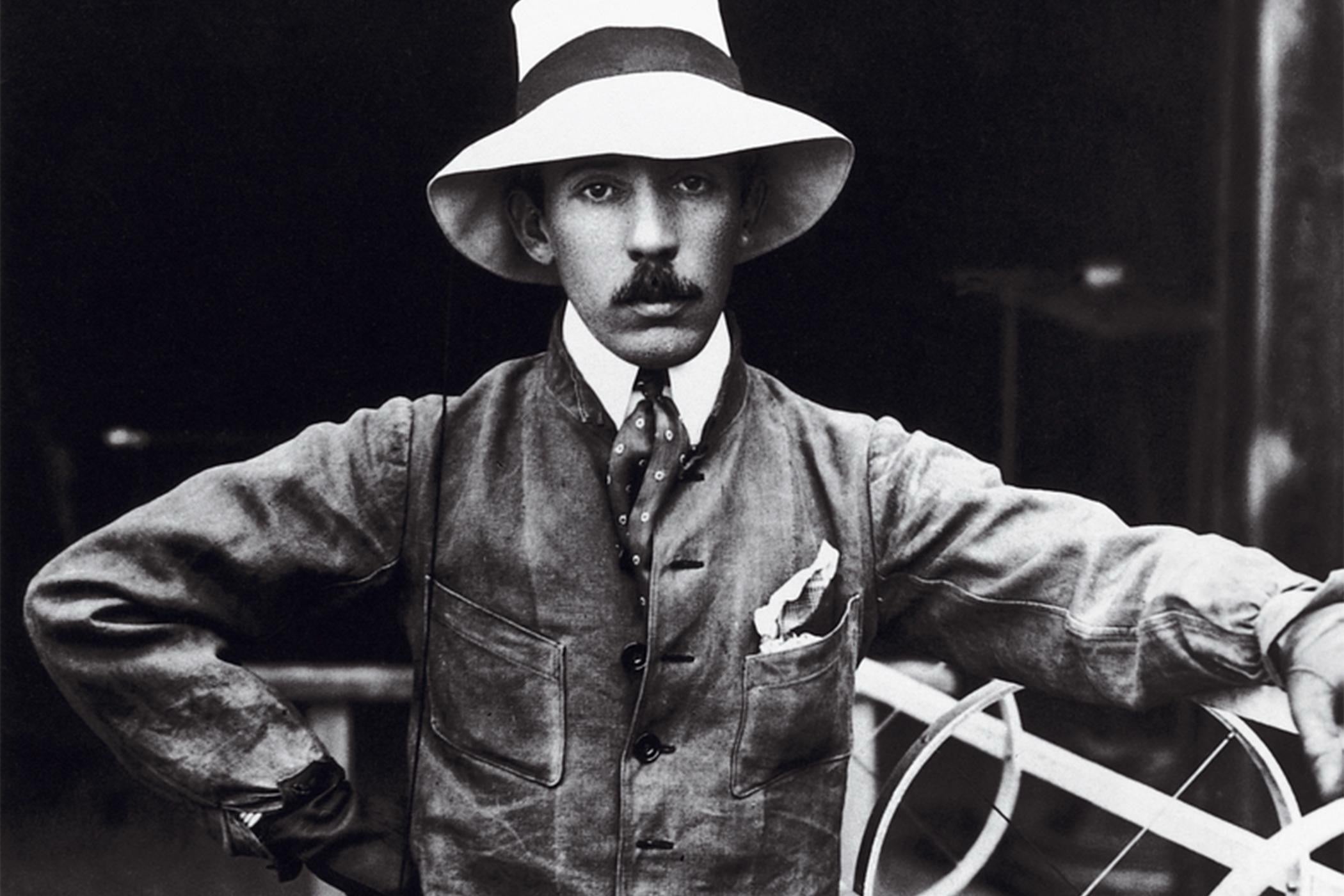
— Its value cannot be explained solely as one of the world’s first practical wristwatches for men —
Cartier’s “Santos” is often introduced as “one of the world’s first practical wristwatches for men.”
It is widely known that in 1904, Louis Cartier made it at the request of Brazilian aviator Alberto Santos-Dumont.
However, that is not the only reason we hold the Santos in such high regard.
From the perspective of someone who has spent many years looking at vintage watches, the true value of the Santos isThe fact that such a highly refined wristwatch design was achieved in 1904were still developing.
It was an era in which wristwatches
Until the early 1900s, pocket watches remained the mainstream.
Wristwatches already existed by the latter half of the 1800s, but most were made as accessories for women, wristwatches adapted from pocket-watch movements, or experimental models not specifically designed as wristwatches.
Comparing wristwatches from that era reveals that many consisted of a round case fitted with a leather strap, and that a fully realized wristwatch design like those of today had not yet been established.
In other words, the goal in this era was to “make a wristwatch,” while the concept of “designing a wristwatch” was only just beginning.
The difference is clear when they are compared in photographs.
[Comparison Photo ①] A typical wristwatch from around 1900

[Comparison Photo ②] 1910 Cartier Santos

The difference is immediately obvious when the two are compared side by side.
Many wristwatches from that era give the impression of being pocket watches adapted to be worn on the wrist.
The Santos, on the other hand, is different.
An original form based on a square case.
A design in which the case and bezel form an integrated whole.
A beautiful silhouette that flows naturally into the lugs.
the overall balance of the dial centered around Roman numerals.
Its individual components do not stand alone;The watch as a whole is complete as a single unified design.
What We Value Is Its Design Perfection
The Santos was a practical wristwatch made for an aviator.
However, what we value even more is that “such a highly refined design was achieved in 1904.”
Proportions that do not feel dated even by modern standards.
The bold challenge of a square case.
The refinement that established the new category of the wristwatch as a beautiful design.
Although it was created more than 100 years ago, the fact that it continues to influence many brands today demonstrates its high level of perfection.
Why It Has Remained Unchanged for More Than 120 Years
Even today, more than 120 years after its creation in 1904, the Santos continues as one of Cartier’s signature collections.
The movement, materials, and size have evolved with the times.
Yet its design is still instantly recognizable as the “Santos.”
Excellent designs do not need to change significantly.
We believe that this very fact proves the Santos’s high level of perfection.
What Makes the Santos Appealing to Ante
When working with vintage watches, we have many opportunities to see wristwatches that are more than 100 years old.
Whenever I look at the Santos among them, I find myself thinking of something.
It is not beautiful despite being an old watch.
It is beautiful because it had already reached perfection more than 120 years ago.
That, perhaps, is the greatest reason the Santos has secured its place in watchmaking history.
Point
- The Santos is a wristwatch made by Louis Cartier in 1904 for Alberto Santos-Dumont.
- It holds an important place in watchmaking history as “one of the world’s first practical wristwatches for men.”
- Compared with wristwatches from that era, the sophistication of its design is striking.
- Even today, more than 120 years later, its basic design remains unchanged, demonstrating its high level of perfection.