


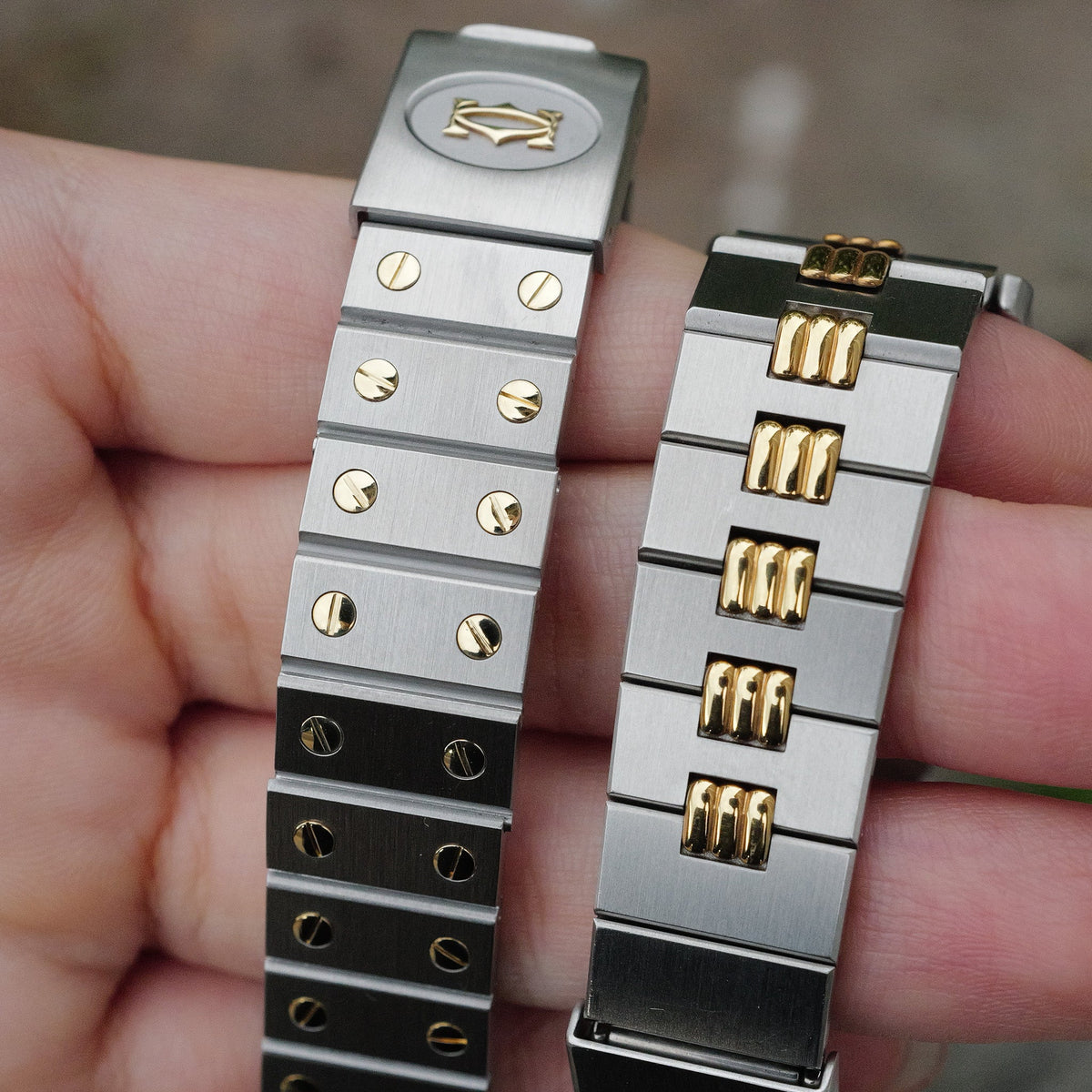
Customers viewing vintage watches sometimes ask us:
“The fewer scratches a watch has, the better its condition, right?”
At first glance, that may seem to be the case.
However, my answer is slightly different, having spent more than 20 years sourcing vintage watches, assessing their condition, and handling a wide variety of timepieces.
Having fewer scratches and being in good condition are not the same thing.
What we consider to be “truly good condition” is how much of the watch’s original appearance remains.
Good condition means preserving its “original appearance”
Vintage watches are not meant to be made as clean as new watches.
What we value is:
The original case.
The original dial.
The original crystal.
And the history the watch has lived through.
We believe that the natural preservation of these elements is what gives a vintage watch its value.
For more information about original dials, please see “What Is an Original Dial?”
Scratches can be removed, but the case cannot be restored
Scratches on a watch can be made less noticeable through polishing.
However, once material has been removed from a case, it cannot be restored.
That does not mean we believe never polishing a watch is always the right approach.
When a case is originally in good condition, fine scratches can be addressed with a minimal finish using an exceptionally soft buffing wheel, without substantially changing the case lines.
At Ante, this kind of minimal finishing is our standard approach.
On the other hand, trying to remove deep scratches can round off edges that were originally sharp and alter the silhouette of the entire case.
We do not perform that kind of finishing.
Once the original lines of a case have been lost, they can never be brought back.
The cleaner a watch appears, the more carefully we inspect it
When sourcing watches, we inspect those that look especially clean with particular care.
Is its beauty truly the result of preserving its original condition?
Or was that beauty created through excessive polishing?
In some cases, the difference cannot be judged from photographs alone.
Rare Cartier models in particular exist in limited numbers, so knowing what their case lines originally looked like is itself an important factor in evaluating them.
At Ante, we bring watches to market only after confirming not just their appearance, but also their original form and silhouette.
The crystal is also part of the watch’s history
We are also often asked:
“The crystal is scratched. Should it be replaced?”
At Ante, however, we do not replace crystals with new ones unnecessarily.
Some Cartier models, particularly those dating from around the 1970s and earlier, use crystals made with period production methods.
The texture and individual variations they possess—qualities not found in today’s mass-produced products—are part of each watch’s unique appeal.
Of course, we may recommend replacement when there is significant chipping or a practical problem.
However, we generally do not replace a crystal merely because it has some signs of use.
Rather than making a watch look new, we value preserving its originality.
Ante’s quality standards
The value of a vintage Cartier is not determined solely by the number of scratches.
The shape of the case.
The character of the dial.
The individuality of the crystal.
The condition of the movement.
And how much of the watch’s original appearance remains.
Only after comprehensively assessing all of these factors do we consider a watch to be truly in good condition.
For more information about the standards Ante uses when bringing watches to market, please see “Thinking Beyond the Sale. That Is Ante’s Quality Standard.”
What makes a truly good vintage watch
What we aim for is not “a watch that looks clean.”
It is a watch that preserves as much of its original appearance as possible and can be confidently passed on for generations to come.
Vintage watches are not about competing to see which one looks as beautiful as new.
They are about carrying each watch’s unique character and history into the future, even after it has passed through many long years.
That, we believe, is their true value.
Ante's Philosophy
The value of a vintage watch is not determined by how few scratches it has.
It lies in respecting the history the watch has lived through, preserving as much of its original appearance as possible, and passing it on to the future.
We believe that this “original beauty” is the most important value of vintage Cartier.


