

— What the word “maison” tells us —
Is Cartier a watchmaker?
Many people would probably answer, “It is a watchmaker,” to this question.
That is not incorrect.
It has created numerous masterpieces that have gone down in watchmaking history, including the Santos, Tank, and Panthère, and today it uses many in-house movements.
However, the more deeply one comes to know Cartier, the clearer it becomes that it is a brand that cannot be fully described by the term “watchmaker” alone.
The reason lies in the order in which Cartier approaches watchmaking.
Cartier began as a jeweler.
Founded in 1847, Cartier was not originally a watchmaker.
It began its history as a maison producing jewelry, creating numerous works for clients around the world, including royalty and aristocracy.
It later began working on watchmaking as well, but its approach differs somewhat from that of a typical watchmaker.
Cartier first envisioned the finished watch.
Many watchmakers create watches while prioritizing performance as mechanisms, including movements, durability, and accuracy.
By contrast, Cartier first considered the finished form—“what kind of watch it wanted to create”—and then chose the optimal technology to realize that world.
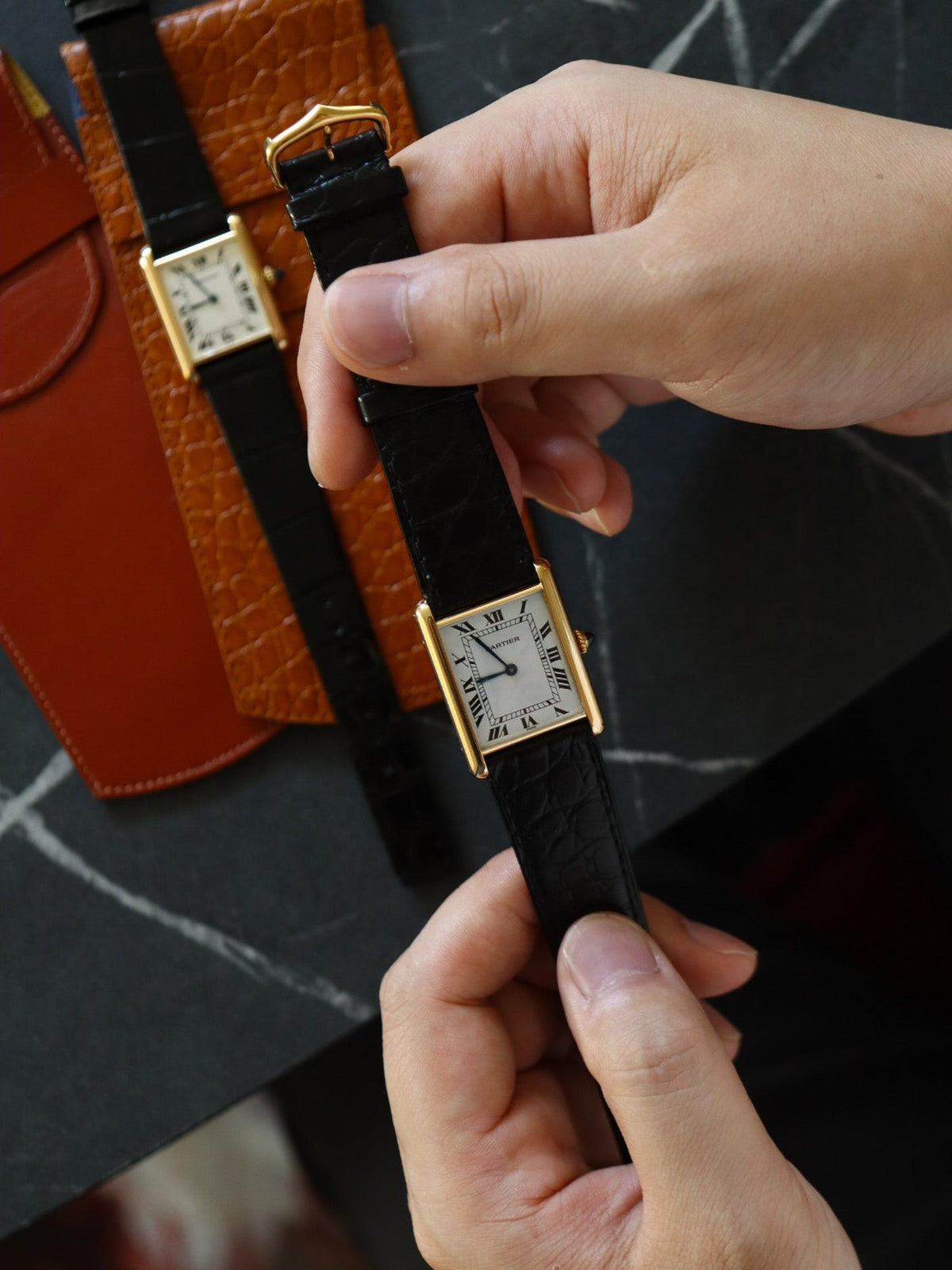
Santos.
Tank.
Panthère.
Baignoire.
In every collection, the shape of the case itself is part of its identity.
Cartier has valued completing each watch as a single work of art, considering not only its design as a mechanism but also the case thickness, proportions, and even its presence on the wrist.
It has chosen the optimal technology for each watch.
That is why, for Cartier, “which movement to use” was not the starting point of watchmaking.
First, it considers “what kind of watch it wants to create.”
Once that answer had been decided, the technology and movement needed to realize it were selected.
Cartier was not committed to completing everything entirely in-house.
To realize the technology best suited to each watch, it has actively incorporated the expertise of specialist manufacturers when necessary.
The fact that vintage Cartier watches use a variety of movements, including Jaeger-LeCoultre, Frédéric Piguet, and ETA, reflects that way of thinking.
For ultrathin dress watches, a slim movement.
For models focused on everyday wear, a movement with excellent practicality.
For sporty models, a structure suited to them.
What mattered was not that the movement was made in-house.
It was to achieve the most complete combination for each watch.
Today’s choice: in-house movements
Today, Cartier actively uses in-house movements.
This does not mean that it rejected its former way of thinking.
It can also be said that an environment has gradually been established in which the design and watchmaking philosophy cultivated over many years can be realized through its own technology.
As times change, technology changes as well.
However, Cartier’s philosophy of valuing the overall perfection of a watch does not seem to have changed significantly.
Why is it called a “maison”?
When Cartier is discussed, the word “maison” is often used.
That is because it is a brand that has built a single world through various forms of craftsmanship, including jewelry, rather than a brand that makes only watches.
A watch, too, is one of the important works that make up that world.
That is why Cartier has always considered not only the movement but also the case shape, dial, bracelet, and even the proportions when worn on the wrist as one complete watch.
Is Cartier not a watchmaker?
We are not saying that “Cartier is not a watchmaker.”
Cartier is unquestionably an outstanding watchmaker.
However, the starting point of its watchmaking differs somewhat from that of a typical watchmaker.
First, it considers what kind of watch it wants to create.
To realize that ideal, it chooses the optimal technology.
That philosophy may be uniquely Cartier, cultivated through its history as a jeweler since its founding.
Before being a brand that made watches, Cartier was a maison that had created beautiful things.
That way of thinking has continued to shape its watchmaking even today, more than 170 years later.
That is why Cartier is called a “maison,” rather than simply a watchmaker.
Point
- Cartier is a maison founded in 1847 as a jeweler.
- Cartier’s watchmaking is characterized by a philosophy that begins with the finished form: “What kind of watch do we want to create?”
- While incorporating the expertise of specialist manufacturers when necessary, it has pursued the optimal configuration for each watch.
- Today it uses in-house movements, but its philosophy of prioritizing the overall perfection of the watch remains consistent.
- Cartier is not only an outstanding watchmaker but also a “maison” that carries on a legacy of design and culture.